
Helping landlords navigate the changing regulatory landscape
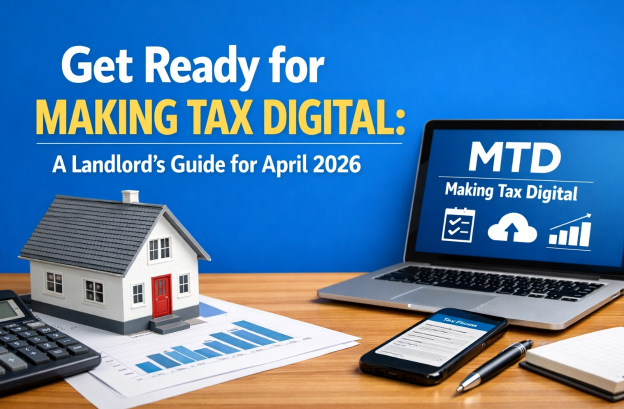
With April approaching, here is a clear, practical update on Making Tax Digital for Income Tax (often shortened to MTD for Income Tax).

MTD is HMRC’s move towards a more digital tax system. For landlords, it means that—if you’re within scope—you’ll move away from a single annual “once-a-year”
Self Assessment process and instead keep digital records and submit regular updates through HMRC-compatible software.
When does it start?
MTD for Income Tax becomes mandatory in phases:
- From 6 April 2026 if your qualifying income is over £50,000 (based on your 2024–2025 tax return).
- From 6 April 2027 if your qualifying income is over £30,000 (based on your 2025–2026 tax return).
- HMRC has also set out plans to expand further (including £20,000), subject to legislation.
What does “qualifying income” mean for landlords?
This is one of the most important points (and one of the most misunderstood).
HMRC looks at your gross income (turnover) from:
- Property income, and Self-employment income (if you have it),
before deducting expenses. If you have both, they are combined for the test.
If you own a rental property jointly, only your share of the income counts towards your qualifying income (not the full property income).
HMRC will often write to people who are affected—but even if you don’t receive a letter, it remains your responsibility to check and prepare.
What changes in practice?
If you’re in scope, you (or your accountant/tax agent) will use MTD-compatible software to:
- Keep digital records of your rental income and expenses,
- Send quarterly updates to HMRC, and
- Submit the end-of-year submissions through the software.
Quarterly updates are aligned to set periods (your software will guide you), and for many people the deadlines are on the 7th of the relevant months after each quarter (for example, the first quarter of 2026/27 is due 7 August 2026).
Do limited companies need to do this?
MTD for Income Tax applies to individuals (sole traders and landlords) rather than limited companies. If you operate through a limited company, this specific change may not apply in the same way (but you may already be using MTD for VAT if VAT-registered).
Can anyone be exempt?
Some people may be exempt (for example, because they are digitally excluded, or do not have a National Insurance number, among other circumstances).
Exemptions are handled by HMRC and in some cases require an application.
More information on UK National Insurance Number - What is a National Insurance Number? | Find your NI Number
How Grange London will support you
We can’t give personal tax advice (that should come from your accountant), but we can make sure you have everything you need from a property-management perspective.
We will:
- Keep your rental statements clear and accessible,
- Provide income summaries and documentation your accountant may request,Help you understand what property data you can expect from us and when,
- Keep you updated as HMRC guidance evolves.
- If you’re unsure whether you’ll be caught in April 2026, now is a good time to speak with your accountant—especially if your rental income is close to the thresholds.
If you’d like us to help you pull together your latest rental income figures from your statements so you can have an informed conversation with your accountant, just email us This email address is being protected from spambots. You need JavaScript enabled to view it.
(Please note: we charge £18 Inc Vat quarterly for statements)
Some FAQ:
1) How do I know if I’m affected from April 2026?
HMRC assesses your qualifying income using your 2024–2025 Self Assessment return. If it’s over £50,000 (property + self-employment combined, gross income), you’ll be mandated from 6 April 2026.
2) Is it profit or turnover (gross income) that matters?
It’s gross income (turnover) before expenses.
3) I own property jointly—does the full rent count?
No. Only your share of the income counts towards your qualifying income.
4) What exactly do I have to submit, and how often?
Quarterly updates (every 3 months) for property/self-employment income sources, plus end-of-year submissions through the software. Your software will guide the dates and process.
5) Do I still submit a tax return?
You’ll submit your end-of-year information through MTD-compatible software as part of the new process (rather than the old single annual online SA journey).
6) Do I have to buy software?
If you’re mandated, you’ll need compatible software (or your accountant will use it on your behalf).
7) I have a limited company—does this apply?
MTD for Income Tax is for individuals (sole traders and landlords). Limited companies are not in scope for this regime (though MTD for VAT already applies if VAT registered).
8) What if I’m not able to use digital systems?
There are exemptions, including for people who are digitally excluded. HMRC sets the rules and handles applications.
9) Can Grange London file my tax returns?
No—tax filing must be done by you or your accountant. We will support with the property documentation and statements you need.
Preparing for Making Tax Digital
Making Tax Digital will change how landlords report rental income. If you would like guidance on preparing your property records or reviewing your letting arrangements, our team would be happy to help.
Useful Links